
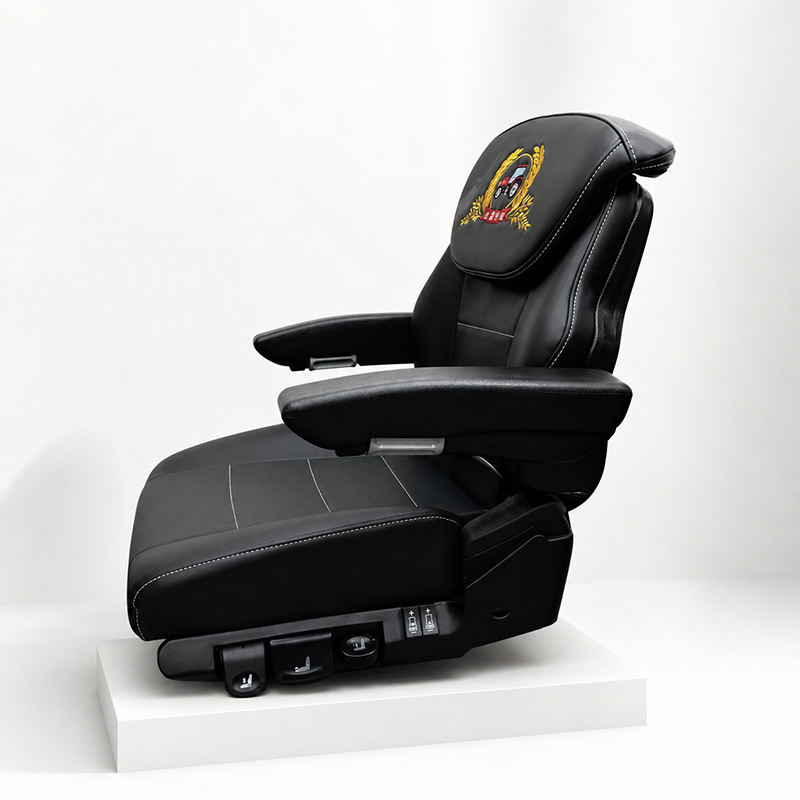
A swivel seat has to pass electrical power through a joint that turns. There are only two ways to do it: a slip ring (continuous contact through rotating brushes or a conductive ring) or a cable loop (a flexible harness that twists and untwists within a limited arc). Most suppliers pick one and never revisit the choice. That is a mistake, because the two fail in completely different ways, on completely different schedules, and one of them can be maintained in the field while the other usually cannot.
This guide sets out how each interface actually behaves, how to calculate the service life you will get, and the criteria that should decide the choice for a given machine.
Quick answer
Cable loops are cheaper and have no contact resistance, but they cap rotation at roughly ±180° and the harness has a finite twist life — typically 50,000 to 200,000 cycles depending on conductor count and bundle stiffness. Slip rings allow continuous 360° rotation indefinitely, but introduce contact wear, electrical noise and a maintenance item that most operators do not inspect. If your operators spin the seat past 180° more than a few times a day, specify a slip ring. If rotation is occasional and stays inside the arc, a cable loop is the more reliable and lower-cost choice.
What each interface actually does
Both interfaces solve the same problem — getting power and signal from a fixed frame into a rotating seat — but they solve it with opposite trade-offs. A slip ring maintains conduction through sliding contact, so it never runs out of travel. A cable loop maintains conduction through a continuous conductor, so it never introduces contact noise, but it accumulates twist with every rotation and has to be given back.
| Property | Slip ring | Cable loop |
|---|---|---|
| Rotation range | Continuous, unlimited 360° | Limited arc, typically ±150° to ±180° |
| Conduction path | Sliding contact (brush on ring) | Continuous conductor, no contact joint |
| Contact resistance | Present, rises with wear and contamination | None; resistance is conductor-only |
| Electrical noise | Arc noise during rotation; can couple into signal lines | None generated by the interface itself |
| Wear mechanism | Brush and ring wear, debris build-up | Conductor fatigue at the twist point |
| Typical life | Ring dependent; 1 to 10 million revolutions for quality units | 50,000 to 200,000 twist cycles |
| Field serviceable | Usually not; module replacement | Sometimes; harness replacement is mechanical |
| Cost at purchase | Higher | Lower |
| Cost over life | Lower if rotation is frequent | Lower if rotation is occasional |
| Failure signature | Intermittent power, noise, dead circuits | Broken conductor, open circuit, usually sudden |
Cable loop life: how to calculate the cycles you actually get
The number that decides whether a cable loop is viable is not the rotation angle — it is the number of twist cycles under load. A twist cycle is one full excursion from neutral to maximum angle and back. If an operator rotates the seat 180° and returns it once per shift, that is one cycle per shift, roughly 600 cycles a year on a two-shift operation. A loop rated at 100,000 cycles will outlive the machine.
The same loop on a machine where the operator swivels constantly — a loader working a stockpile, a telehandler loading trucks — can see 300 or more cycles per shift. At 600 cycles a day, a 100,000-cycle loop is consumed in under 170 working days.
| Duty pattern | Rotations per shift | Cycles per year (2 shifts, 250 days) | 100,000-cycle loop lasts |
|---|---|---|---|
| Occasional (inspection, entry/exit) | 1 to 3 | 500 to 1,500 | Over 60 years — effectively unlimited |
| Moderate (mixed field work) | 10 to 30 | 5,000 to 15,000 | 7 to 20 years |
| Frequent (yard and loading work) | 60 to 150 | 30,000 to 75,000 | 1.3 to 3.3 years |
| Continuous (stockpile, transfer) | 200 to 400+ | 100,000 to 200,000+ | Under 1 year |
Two factors shorten loop life well below the nominal rating. First, conductor count: a loop carrying twelve conductors has less room for each to move, so the bend radius at the twist point is tighter and fatigue arrives sooner. Second, bundle stiffness: a harness with thick power conductors bundled alongside signal wires resists twisting, and the resistance concentrates at the point where the bundle is clamped.
The clamping detail that decides loop life
Most cable loop failures happen not in the middle of the free length but right at the clamp. If the harness is clamped hard at both ends with no strain relief, all the twist is absorbed in a very short span and the conductors work-harden and break. A correct installation gives the harness a free length of at least eight times the bundle diameter, clamps one end rigidly, and allows the other end to rotate with a loose guide rather than a hard clamp. Where the design permits, a spiral or helical routing distributes the twist along the whole length instead of concentrating it.
Field symptom to check first
A cable loop that is about to fail usually shows intermittent faults that appear only at a particular rotation angle — power drops out near full lock and returns when the seat comes back. That angle-specific behaviour is the signature of a partially broken conductor. A slip ring with the same symptom is more likely suffering contamination or brush wear. The diagnostic path is completely different, which is why the interface type should be written on the maintenance record.
Slip ring behaviour: what the datasheet does not tell you
Slip ring life is quoted in revolutions, which sounds generous until you convert it to years of real duty. A unit rated at 5 million revolutions sounds like it will outlast the machine — and for an occasional-use seat it will. But at 300 rotations per shift, two shifts a day, 250 days a year, that is 150,000 revolutions a year, and the ring is consumed in about 33 years of that duty. That is still acceptable. The problem is not the nominal life; it is that rated life assumes clean, dry, low-current operation.
| Condition | Effect on contact | Practical consequence |
|---|---|---|
| Dust and grit ingress | Abrasive wear between brush and ring | Resistance climbs, noise increases, life can halve |
| Condensation and wash-down | Film formation on the ring surface | Intermittent open circuit, especially at low current |
| High current density | Localised heating at the brush contact | Ring surface oxidises, resistance rises further |
| Low current signal circuits | Insufficient current to break through surface film | Signal dropouts that do not show under bench test |
| Vibration | Brush bounce | Transient arcing and electrical noise |
The low-current case deserves emphasis because it is the most commonly missed. A slip ring that carries a 10 A compressor supply happily will often fail to carry a 20 mA sensor signal reliably, because the low current cannot break through the oxide and contamination film that the high-current circuit burns away. In practice this means a ring that passes a bench continuity test can still produce intermittent sensor faults in the field.
Pairing rotation with a high-current load
An electric suspension seat adds a compressor to the circuit. On a swivel seat, that compressor current has to cross the rotation interface too, which changes the slip ring specification substantially. Two rules apply. First, size the power ring for the compressor's starting current, not its running current — an induction compressor can draw three to six times running current for a fraction of a second on each start. Second, keep the compressor supply on a separate ring from the signal circuits, both physically and in the wiring, so that arcing on the power ring does not couple into sensor lines.
Decision criteria for a given machine
The choice should be made from the duty pattern, not from the price list. Work through these four questions in order.
- Does the operator need more than ±180° of rotation? If yes, a cable loop cannot serve the application regardless of cost, and the discussion ends at the slip ring.
- How many twist cycles per year? Use the table above. Below roughly 10,000 cycles a year, a cable loop is the lower-risk choice because it removes the contact-wear failure mode entirely.
- Is the machine washed down or exposed to dust? Wash-down and abrasive dust both attack sliding contacts. In those environments a cable loop, if the rotation range allows it, is materially more reliable.
- Is field service practical? A cable loop failure can often be repaired with a replacement harness in a workshop. A slip ring failure generally means replacing the module, which ties up the machine and requires the part.
| Application | Typical rotation | Recommended interface | Reason |
|---|---|---|---|
| Tractor field work, occasional turning | Under ±90° | Cable loop | Low cycle count, no contact wear |
| Telehandler loading trucks | Frequent, within arc | Cable loop with helical routing | Count is high but stays inside arc; avoid contact noise |
| Loader at stockpile, continuous swivel | Continuous 360° | Slip ring, power and signal on separate rings | Loop would be consumed within a year |
| Municipal tractor with front loader and rear implement | Continuous 360° | Slip ring | Operators routinely spin past 180° |
| Machine with wash-down requirement | Any | Cable loop where range allows, else sealed slip ring | Sliding contacts degrade under water and chemical ingress |
Specification items to put in the purchase order
Whichever interface you specify, the order should fix the parameters that determine whether it lasts. Leaving them to the supplier's default is how a seat rated for occasional use ends up on a machine that swivels all day.
| Field | What to state | Why it matters |
|---|---|---|
| Rotation range required | Angle in degrees, or "continuous" | Decides whether a loop is even eligible |
| Duty cycle | Rotations per shift, shifts per day | Sets the life requirement |
| Conductor count and type | Power conductors, signal conductors, current per circuit | Determines bundle stiffness and ring sizing |
| Interface type | Slip ring or cable loop, named explicitly | Prevents substitution during sourcing |
| Signal sensitivity | Whether CAN, sensor or analogue signals cross the interface | Drives shielding and separation requirements |
| Environmental rating | IP class required, wash-down, dust exposure | Sets sealing level for contacts |
| Service access | Whether the interface is field replaceable without seat removal | Determines downtime on failure |
| Life target | Cycles or revolutions expected over machine life | Gives the supplier a number to design to |
One further item is worth stating even though it is not an interface parameter: require the supplier to identify the interface type on the seat's label or documentation. Maintenance technicians diagnose faults differently depending on whether they are looking at a sliding contact or a twisting harness, and the wrong diagnostic path wastes hours.
Maintenance and inspection: what to do at each service interval
A rotation interface that is never inspected is a latent failure. Both types are inspectable, but they need different checks, and the checks are quick enough to fold into an existing service schedule.
| Interval | Slip ring check | Cable loop check |
|---|---|---|
| Every 500 hours | Visual: dust or film on the ring housing; listen for arcing during rotation | Visual: chafing or shiny wear at the clamp; flex the free length by hand and feel for stiffness |
| Every 1,000 hours | Measure contact resistance per circuit against the commissioning value | Check conductor continuity end to end while rotating slowly through the full arc |
| Annually | Inspect brush length and ring surface where accessible; replace module if resistance has risen more than 20% | Inspect the whole free length for broken strands; replace harness if any conductor is intermittent |
| On any intermittent fault | Clean the ring surface, then re-measure; if the fault persists, replace the module | Rotate slowly to the angle where the fault appears — that localises the break |
The single most useful commissioning action is to record a baseline. Measure and write down the contact resistance of each slip ring circuit, or the continuity of each cable loop conductor, at installation. Without a baseline, a technician has no way to tell whether a reading taken two years later represents normal wear or an impending failure. This takes ten minutes at commissioning and saves diagnostic time for the life of the machine.
A note on intermittent faults
Intermittent electrical faults on swivel seats are frequently misdiagnosed as control unit problems, because the control unit is where the fault surfaces. Before replacing a controller, check the rotation interface. The tell is whether the fault correlates with seat position or with time since start-up — a positional correlation points to the interface, not the electronics.
Common procurement mistakes
- Buying on rotation range alone. A seat advertised as "360° swivel" may achieve it through a cable loop with a generous arc and a hard stop — it will rotate, but the loop will fail early on a machine that actually uses the full range.
- Assuming slip ring life is unlimited. It is long, not infinite, and it degrades faster than rated in dust and moisture. A maintenance interval should exist.
- Ignoring the compressor current. Retrofitting an electric suspension seat onto a swivel base sized for signal-only wiring overloads the interface. The compressor starting current has to be in the specification.
- No record of what was fitted. When a fault appears two years later, nobody knows whether to look for a broken conductor or a worn brush. Record it at installation.
- Replacing a cable loop with a slip ring without re-checking the circuits. The two interfaces have different shielding and separation requirements. A swap that fixes the wear problem can introduce noise problems in the signal circuits.
Related: rotation locks, cable routing and safety verification
This guide covers the interface in isolation. The companion article covers how the rotation lock, interlock strategy and clearance envelope interact with the electrical path, and the checks to run before sign-off.
Frequently asked questions
Can a cable loop be used for continuous rotation?
No. A cable loop has a finite twist capacity by construction. Continuous 360° rotation without a return path will consume the harness in a short number of turns. If continuous rotation is required, a slip ring is the only viable interface.
How do I know which interface a seat has before I buy it?
Ask directly, and ask for the conductor count and rotation limit. A supplier who cannot state the rotation limit is selling a cable loop and has not measured it. A slip ring is normally described with a revolution rating and a conductor count per ring.
Does a slip ring always add noise to the electrical system?
It adds noise during rotation, when contact is being made and broken at the brush. A stationary ring is quiet. Whether that noise matters depends on what shares the harness and how the signal circuits are shielded and separated. High-current compressor circuits on the same ring as sensor signals are the usual cause of trouble.
What is the most common cause of a swivel seat electrical failure in the field?
For cable loops, conductor fatigue at the clamp point. For slip rings, contamination or film build-up on the ring surface. Both present as intermittent faults, but a cable loop fault usually tracks a specific rotation angle while a slip ring fault tends to appear after a period of sitting, or in damp conditions.
Need a seat matched to your machine?
Send us the mounting dimensions, vehicle model and operating conditions. We will confirm the suspension type, adjustment range and mounting plate that fit, and quote accordingly.