
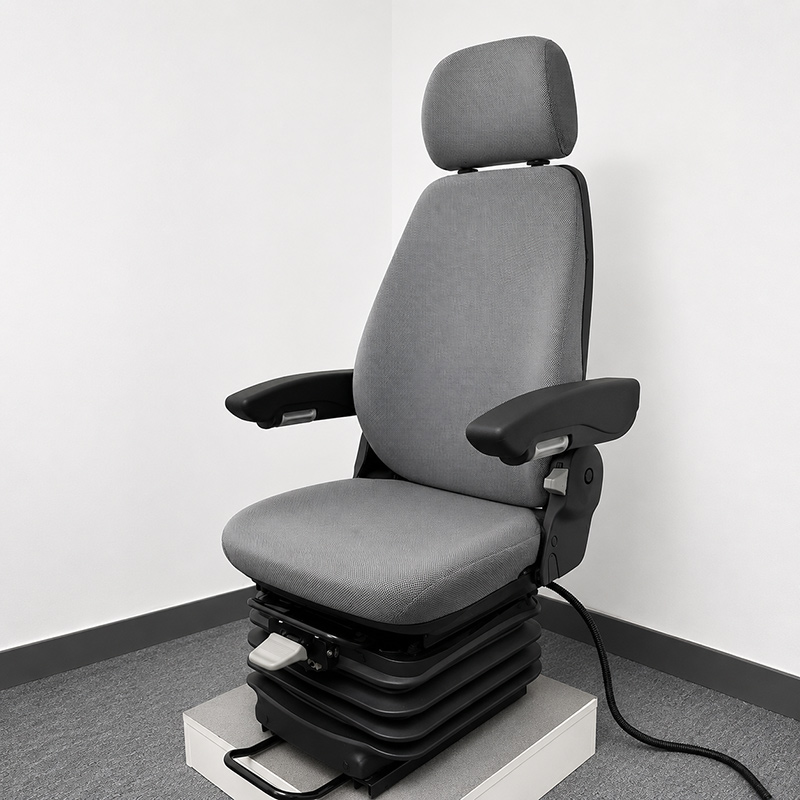
Whole-body vibration is one of the few machine hazards that is invisible in a specification sheet but measurable in the cab. It accumulates over a shift, it is not eliminated by a comfortable cushion, and it is the reason suspension seats exist at all.
For a purchasing engineer, the practical question is narrower: how do I translate a vibration standard into a seat specification I can put in a purchase order? This article answers that question with the numbers.
Quick answer
ISO 2631-1 evaluates whole-body vibration using frequency-weighted acceleration and the daily exposure action value of 0.5 m/s² A(8), with a limit value of 1.15 m/s² A(8). Tractor work frequently exceeds the action value on unsuspended or mechanically suspended seats. The fix is a seat with a low natural frequency, adequate stroke and damping tuned to the dominant cab frequency — typically 1.5 to 4 Hz for the sprung mass of a tractor.
Why the seat, not the chassis, is the control point
Tractor vibration comes from three sources: engine and driveline order, tyre and ground interaction, and implement loading through the three-point linkage. Tyre and ground input dominates in the 1 to 8 Hz band, which happens to be the band where the human body is most sensitive and where the seat's own suspension operates.
That overlap is what makes seat suspension effective. A seat with a natural frequency around 1.2 to 1.5 Hz and damping in the 0.2 to 0.35 range attenuates the 2 to 6 Hz input that reaches the operator. A seat whose natural frequency sits inside the dominant input band amplifies instead of attenuating.
| Band | Typical source | Relevance for the seat |
|---|---|---|
| 0.5 – 1 Hz | Ground undulation, field ridges | Needs long stroke; suspension must not bottom out |
| 1 – 4 Hz | Tyre and axle, sprung mass resonance | The main design band for the seat suspension |
| 4 – 8 Hz | Cab structure, engine mounts | Where the seat cushion and damping do most of the work |
| 8 – 20 Hz | Engine order, hydraulics | Attenuated by cushion material and frame isolation |
| Above 20 Hz | Panels, trim, steering column | Not a seat issue; solved by trim and mounting isolation |
Reading an ISO 2631 exposure value
ISO 2631-1 defines a frequency-weighted RMS acceleration, written aw, in units of m/s². Because vibration exposure is cumulative, the standard also defines A(8): the equivalent eight-hour exposure. If an operator is exposed for four hours, the measured value is scaled up to an eight-hour equivalent.
| Threshold | Value | Obligation |
|---|---|---|
| Exposure action value | 0.5 m/s² A(8) | Take action: inform operators, provide information, consider controls |
| Exposure limit value | 1.15 m/s² A(8) | Must not be exceeded; redesign or restrict exposure time |
| Vibration dose value (VDV) action | 9.1 m/s1.75 | Used where shocks dominate — common on tractors on unmade ground |
| VDV limit value | 21 m/s1.75 | Absolute ceiling for the VDV metric |
The VDV metric deserves attention for agricultural work. RMS values average out shocks. A tractor hitting potholes and field ridges produces shocks that the RMS number understates. ISO 2631 therefore allows a fourth-power dose measure, the VDV, which responds much more strongly to peaks. Where the crest factor exceeds 9, the standard recommends using VDV.
Transmissibility, and why a cheap seat can make vibration worse
Transmissibility is the ratio of acceleration measured on the seat top to acceleration measured at the cab floor. A transmissibility below 1 means the seat is attenuating. Above 1 means the seat is amplifying.
Every suspension seat has a resonant frequency where transmissibility peaks. If that peak falls inside the tractor's dominant input band, the operator feels more vibration than with a rigid seat.
| Specification | What to request | Acceptance guidance |
|---|---|---|
| Natural frequency | The measured value, not a nominal one | 1.0 – 1.6 Hz for agricultural use |
| Peak transmissibility | Maximum value on the curve | Below 2.0 at resonance |
| Transmissibility at 4 Hz | Value at the dominant cab frequency | Below 0.8 |
| Damping ratio | Measured, not assumed | 0.2 – 0.35 |
| Stroke | Usable stroke, not total travel | 60 mm minimum; 80 mm or more for rough ground |
| Test method | How the curve was measured | Shaker table test per ISO 10326-1 preferred |
ISO 10326-1 is the test method standard for laboratory evaluation of vehicle seat vibration. A supplier who can provide results to that method is a supplier who has actually measured the seat rather than estimated it.
Suspension types and where each one is appropriate
| Type | How it works | Strengths | Limitations |
|---|---|---|---|
| Mechanical spring and damper | Coil or torsion spring with a hydraulic damper | Simple, no electrical supply, low cost | Adjustment limited to operator mass; tuning is fixed |
| Air suspension (pneumatic) | Air bellows with a level valve | Self-levelling across a wide mass range; smooth | Needs air supply or onboard compressor; air line maintenance |
| Electric air suspension | Onboard compressor, electronic control, air bellows | Self-levelling, response to load, adjustable firmness | Electrical supply required; compressor is a wear item |
| Active or semi-active | Sensor-driven actuator or variable damper | Best attenuation across a wide band | Highest cost and complexity, needs diagnostics |
| Scissor linkage (low profile) | Short-travel linkage for limited headroom | Fits low cabs | Shorter stroke, less attenuation on rough ground |
Specifying a seat to reduce measured exposure
The aim is not to buy the most expensive suspension. It is to buy the suspension that moves the measured exposure below the action value at the actual duty cycle.
- Measure the baseline. Fit an accelerometer at the seat base and at the seat top, run a representative duty cycle, and record aw and VDV.
- Identify the dominant frequency. A one-third octave plot shows where the energy sits; that is the frequency the seat must attenuate.
- Match the seat natural frequency below the dominant input. For a 3 Hz dominant input, a seat at 1.2 to 1.5 Hz attenuates; a seat at 2.8 Hz amplifies.
- Confirm stroke against the worst ground. The stroke must swallow the largest displacement the site produces, without bottoming out.
- Re-measure after fitting. Compare aw and VDV before and after; that comparison is the evidence that the purchase was justified.
Duty cycle and the arithmetic of exposure time
Because A(8) is a daily equivalent, exposure time is a design variable. Halving the time on the roughest ground cuts the dose, which is why exposure rotation is a legitimate control alongside a better seat.
| Time on task | Scaling factor | Measured 1.0 m/s² becomes |
|---|---|---|
| 8 hours | 1.00 | 1.00 m/s² A(8) |
| 6 hours | 0.87 | 0.87 m/s² A(8) |
| 4 hours | 0.71 | 0.71 m/s² A(8) |
| 2 hours | 0.50 | 0.50 m/s² A(8) |
| 1 hour | 0.35 | 0.35 m/s² A(8) |
The table is illustrative because real vibration is not constant, but the scaling relationship holds and it explains a common observation: two operators on the same machine can have very different exposure simply because one spends more of the shift on unmade ground.
Design details that affect the measured result
- Cushion thickness and foam density — a thick soft cushion feels good initially but can amplify in the 4 to 8 Hz band as the foam compresses.
- Frame isolation — rubber isolators between the seat frame and the pedestal attenuate high-frequency content that the suspension cannot address.
- Backrest coupling — vibration transmitted through the backrest reaches the torso as well as the pelvis; the backrest should be part of the suspension system, not bolted to a rigid frame.
- Armrest mounting — armrests bolted to the cab rather than the seat break the isolation path and reintroduce vibration at the shoulders.
- Belt routing — a belt that constrains the operator to the seat also couples the operator to the seat frame; ensure the routing does not bypass the isolation.
How vibration shows up as an operator problem
| Operator complaint | Likely parameter | Direction of the fix |
|---|---|---|
| Lower back pain after a shift | Elevated aw in the 4 to 8 Hz band | Better damping and cushion, not a thicker cushion |
| Headache and blurred vision | Energy above 8 Hz reaching the head | Frame isolation, trim, and reduced shock input |
| Jarring over potholes | High VDV, suspension bottoming out | Longer stroke and correct preload |
| Neck and shoulder tension | Backrest and armrest coupling | Suspend the backrest; mount armrests to the seat |
| Fatigue without pain | Cumulative dose near the action value | Reduce time on task and re-measure |
Where to start if you have no measurement data
Most buyers start without a measurement programme. In that case, use the machine's own characteristics as a proxy and specify conservatively.
- Assume the dominant input is at the tractor's sprung-mass resonance, which is usually between 1.5 and 3 Hz on a laden machine.
- Specify a seat with a measured natural frequency at or below 1.5 Hz and a peak transmissibility below 2.0.
- Specify usable stroke of at least 80 mm for any machine that works unmade ground.
- Require a shaker-table test report to ISO 10326-1, not a marketing graph.
- Plan a before-and-after measurement on one machine before rolling the seat out across a fleet.
Frequently asked questions
Is a thicker cushion a substitute for a suspension seat?
No. Foam attenuates high-frequency content but does nothing for the 1 to 8 Hz band where most tractor energy sits. Thick soft foam can even amplify in that band as it compresses.
Does an air suspension seat always reduce exposure?
Only if its natural frequency sits below the dominant input and it has enough stroke. A poorly matched air seat will feel softer while measuring no better, or worse, than a rigid seat.
How often should the suspension be inspected?
Inspect the bellows, dampers and linkage at each major service interval, and pressure-test the air circuit annually. A leaking bellows reduces stroke and increases bottoming-out, which shows up as a rise in VDV.
Can I compare two seats using only catalogue data?
Only if both catalogues report natural frequency, peak transmissibility and stroke to the same test method. Without a stated test method, transmissibility figures are not comparable.
What is a typical action-level exceedance in agriculture?
Reports commonly find unsuspended or mechanically suspended tractor seats exceeding the 0.5 m/s² A(8) action value on mixed field and road duty. The exact figure depends on the ground, speed and tyre specification, which is why measurement is the only reliable basis.
Does tyre choice affect seat specification?
Yes. Tyre size, pressure and tread pattern change the frequency content reaching the cab. Correct tyre pressure for the load often reduces input at source more cheaply than a seat upgrade, so do both.
Do I need a different seat for a tracklayer versus a wheeled tractor?
Tracked machines generally produce lower amplitude but different frequency content. Specify from measurement where possible; where not, keep the same natural frequency target and confirm stroke against the ground conditions.
}Before you specify, check fitment
Suspension performance is irrelevant if the seat will not bolt into the cab or run from the machine supply. Our fitment and wiring checklist covers mounting patterns, compressed height and 12 V / 24 V integration.
Need a seat matched to your machine?
Send us the mounting dimensions, vehicle model and operating conditions. We will confirm the suspension type, adjustment range and mounting plate that fit, and quote accordingly.